Early Warning System for Avian Influenza
Bird Flu Radar: Operationalizing Real-Time Risk Assessment for HPAI in Europe
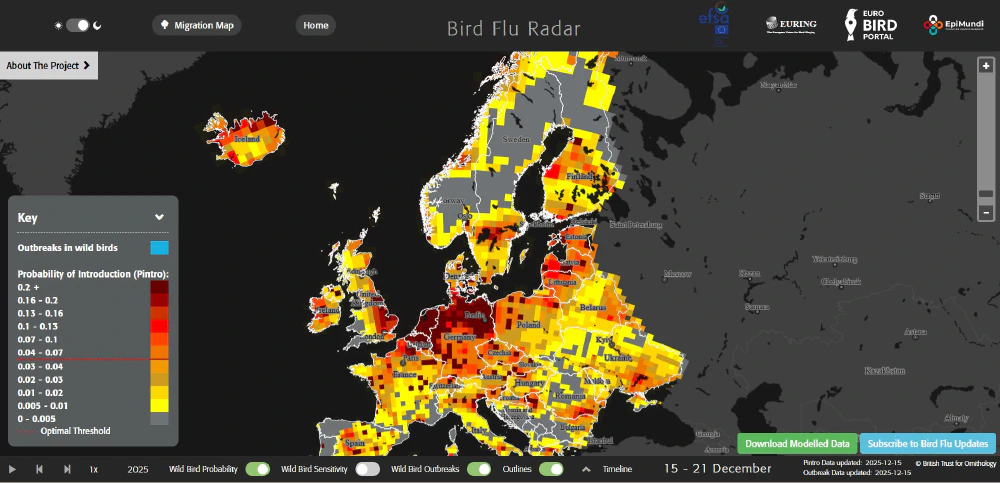
Highly Pathogenic Avian Influenza (HPAI) represents a persistent and evolving threat to biodiversity and poultry production across Europe. To address this, the European Food Safety Authority (EFSA) commissioned the Bird Flu Radar, a sophisticated graphical user interface (GUI) developed under the project ‘Implementation of an Early Warning System for Highly Pathogenic Avian Influenza’ (NP/EFSA/BIOHAW/2022/01).
The core objective of this initiative is to move beyond static mapping. The project has developed a dynamic spatiotemporal risk assessment model that estimates the probability of HPAI outbreaks within wild bird populations across discrete spatiotemporal units in Europe. Building on a successful pilot phase, the system has evolved into a fully operational early warning tool.
Synergistic Modeling: Integrating Abundance, Movement, and Epidemiology
The strength of the Bird Flu Radar lies in its integration of heterogeneous data streams through a multi-partner collaboration:
- Project Coordination: Led by Sovon (Dutch Centre for Field Ornithology).
- Abundance & Distribution: The Catalan Ornithological Institute (ICO) leverages vast datasets from the EuroBirdPortal (EBP)—including citizen science data—to estimate the relative abundance of 12 key wild bird species known to vector HPAI.
- Movement Dynamics: The British Trust for Ornithology (BTO) utilizes banding and recovery data from the EURING DataBank. They provide critical estimates for both long-distance migratory movements and short-distance dispersal models for the target species.
- Risk Modeling: EpiMundi (formerly Ausvet Europe) synthesized these inputs to develop the core spatiotemporal risk assessment model. This engine processes the biological data to generate probabilistic risk layers.
Real-Time Intelligence
The model is not a static snapshot; it is a living system. Every Monday morning, the risk assessment is recalculated and updated based on the latest reported HPAI outbreaks (H5 and H7 strains) in wild birds across Europe. This provides authorities and researchers with a weekly, up-to-date visualization of risk landscapes, enabling timely, data-driven biosecurity decisions.
A comprehensive methodological description is detailed in the 2022 EFSA External Scientific Report. The model will undergo continuous refinement and validation until the project’s conclusion in 2025.
Key Project Resources
Scientific Foundation: Development of a prototype early warning system for avian influenza in the EU based on risk-mapping (EFSA External Scientific Report, 2022)
- Read the Full Report
The Tool: Bird Flu Radar (Weekly updates based on latest outbreak data)
- Access the Interface
Training: Explainer Video on Model Functionality
- Watch the Video