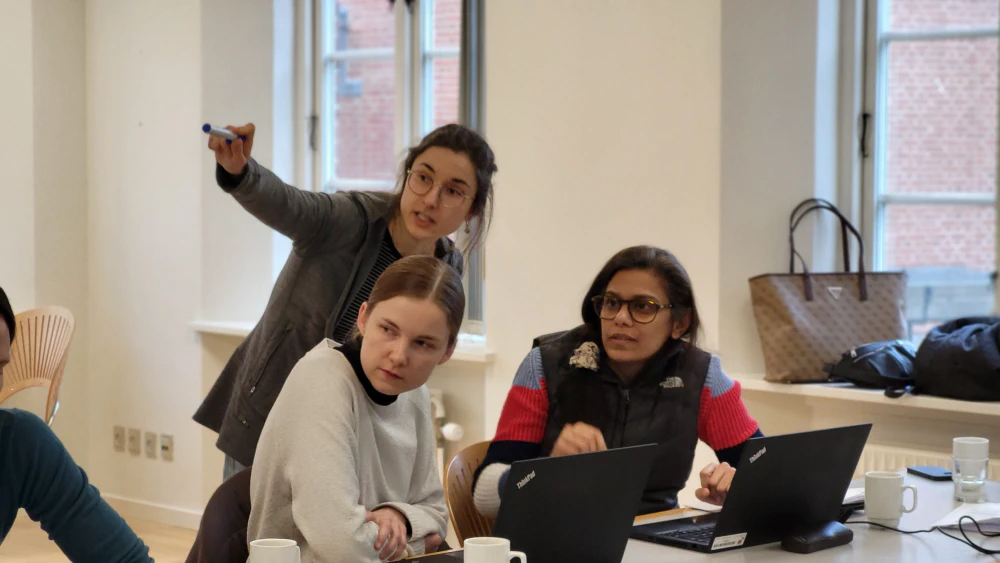
Training and workshop facilitation
Our team comprises several highly experienced trainers and workshop facilitators and we regularly provide training or run workshops to groups within government agencies, industry or other organisations within the private sector. Face to face training is always more powerful but we are also experienced on-line trainers.
We combine technical expertise and wide-ranging practical experience to offer training that covers technical fundamentals and theory for any topic and that includes hands-on practical training to reinforce the acquisition of knowledge and skills in our participants.
We have run training courses in many countries around the world, ranging from introductory level courses to advanced and highly technical training.
All of our courses are interactive and provide lots of engaging opportunities to exchange experience, solve problems and discuss issues.
We use real-life examples and material crafted for each group and context. Courses have an emphasis on group discussion and challenging exercises that bridge the gap between theory and practice.
Delivering flexible, responsive training has always been an important part of our work and for many courses participants are encouraged to use current work challenges or data sets as the focus of their skills development. This approach leads to more rapid acquisition of skills as well as useful outputs. We offer completely customised training to suit our clients’ needs.
We use real-life examples and material crafted for each group and context. Courses have an emphasis on group discussion and engaging exercises that bridge the gap between theory and practice.
Apart from courses developed for specialised purposes, we offer an array of foundational training courses as well as extended workshops which focus on real-world problem solving.
- Introduction to epidemiology
- Surveillance system design and implementation
- Aquatic animal disease surveillance
- Introduction to R language and its environment
- Risk assessments and introduction to risk analysis
- Freedom: Analysis of complex surveillance systems for demonstration of disease freedom
- Data governance
- Data management and database development
- Field survey techniques
Developed by a collaborative team including Angus Cameron, the ‘Freedom methodology’ has now become an international standard. Angus has delivered the course to hundreds of epidemiologists around the world and is considered a world leader on the subject. Courses commonly include the following modules:
- Purpose of disease surveillance
- Concepts of freedom from disease / infection
- Requirements for the analysis of non-random surveillance systems
- Introduction to scenario-tree modelling
- Capturing risk and targeting in a scenario-tree
- Expert opinion and other sources for parameter estimates
- Stochastic modelling
- Combination of components
- Calculation of probability of freedom
- Incorporation of historical surveillance data
- Digital tools for scenario-tree modelling